Data Engineering · Professional consulting
DENSO Argentina
Turning a manual and opaque foreign trade process into a reproducible, traceable and verifiable solution.
α
Context
The Commercial Manager needed to estimate how much cash had to be available to cover commitments for the following period.
The calculation already existed, but it depended on a manual process built around ERP reports, external information, Excel spreadsheets, manual corrections, cross-checks and calculations performed by the process owner.
The initial objective was to automate or semi-automate that workflow so it could become more consistent, traceable and operable.
β
Problem
There was no formal specification that could simply be translated into software.
The operator knew which files to use, what to modify, what information to cross-check and which steps led to the expected result, but part of the underlying logic remained implicit in spreadsheets and accumulated operational experience.
Before automating anything, the real process had to be reconstructed: what it actually did, why it did it and which rules had to be preserved.
γ
Discovery and formalization
I worked directly with the process owner to reconstruct the workflow step by step: sources, files, transformations, corrections, cross-checks and expected outputs.
When a rule was unclear, I analyzed how the case was resolved manually, formulated possible interpretations and validated them with the responsible stakeholders before turning them into system behavior.
I also worked with the Commercial Manager to understand the accounting impact of the results and the financial need the solution had to answer.
- Tacit knowledge converted into explicit requirements
- Business rules and validation criteria
- Sources and transformations identified
- Operational exceptions formalized
δ
Solution design
I proposed a local, deterministic ETL as the appropriate solution.
Based on the reconstructed process, I designed an architecture capable of receiving heterogeneous sources, processing them through explicit stages and producing a consolidated, reproducible output.
- Parsing and normalization
- Reconciliation
- Business keys
- Historical, baseline and incremental processing
- Snapshots and idempotency
- Data contracts, validations and testing
ε
Build and operation
Development followed an incremental approach. Early deliveries addressed the critical operational needs, and additional rules, reconciliations and edge cases were incorporated as they were discovered through use and validation.
The solution was delivered as a self-contained ETL for Windows, designed to run locally from a USB drive without depending on external infrastructure.
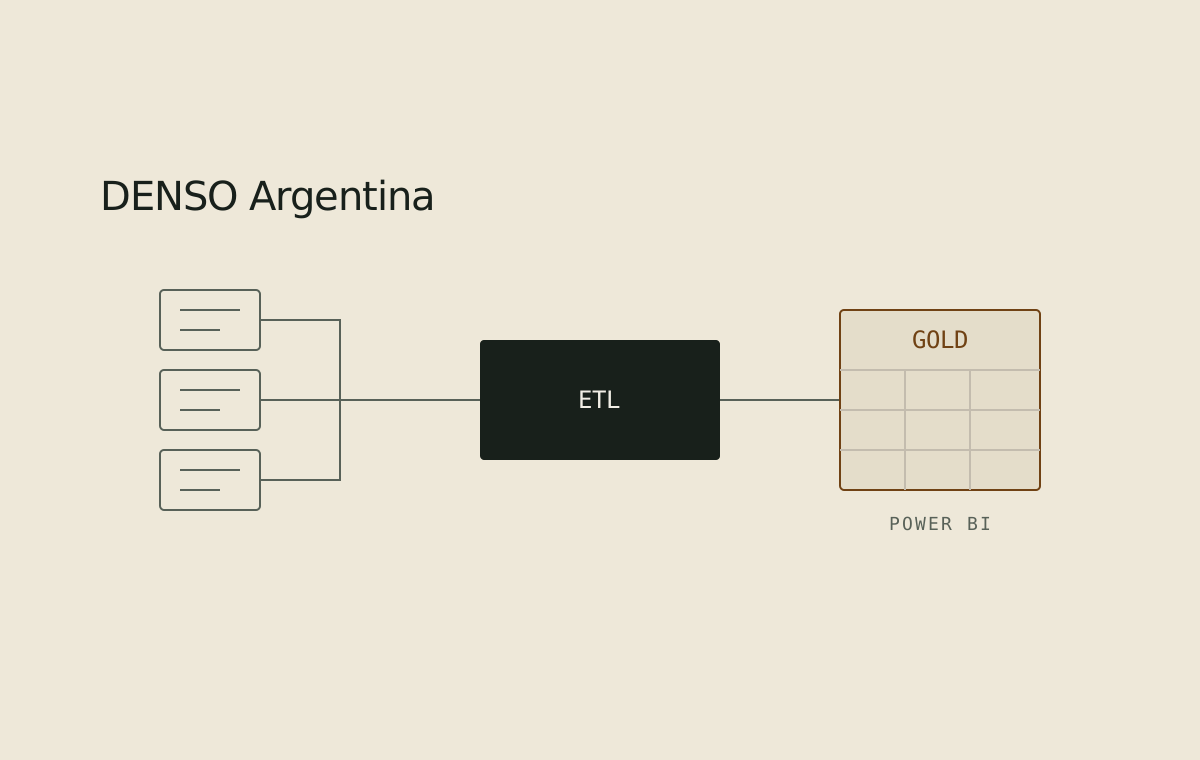
The process produces a Gold table consumed by Power BI and is accompanied by documentation of the operating methodology.
ζ
Result
The process moved from multiple manual operations, files and implicit knowledge to a reproducible, traceable and verifiable workflow.
The time required to complete the main calculation went from approximately one week to approximately one hour.
The delivery chain became explicit from operational sources through the local ETL and Gold table to the information consumed in Power BI.
η
Technologies and public scope
Python, DuckDB and Parquet form the processing core, with Excel, Power BI, Git and Windows supporting operation and delivery.