Business Intelligence / Product & Data · Professional consulting
Lear Corporation
Turning SAP PM and maintenance data into an operating maintenance-management system guided by TPM principles.
α
Context
Lear already had SAP PM, but the system was not yet functioning as the operational foundation for maintenance management.
Much of preventive and corrective maintenance was managed through Excel and manual processes. Preventive plans and historical information existed, but asset data needed to be updated, operating specifications and work instructions were incomplete, and there was no common data-driven methodology.
The objective set by General Management was to make SAP PM the operational foundation of the maintenance area.
Management defined the overall objective; I had autonomy to define the methodology, priorities, information structure, asset-criticality criteria, technical solution and how the new operating policy would be deployed across the plant.
β
Problem
Enabling a software tool was not enough. The asset information had to be reconstructed and updated, the way the area worked had to be defined, and a common methodology for recording and using maintenance information had to be established.
Maintenance indicators also had to reflect the real behavior of the plant. That required defining what counted as a failure, how events should be recorded, which assets deserved priority and how interventions should be interpreted.
γ
Building the operational foundation
I updated the asset structure and information available in SAP PM, working across more than 60 machines.
Technical and operational documentation was structured for the equipment, including machine dossiers, layouts, procedures and instructions required to support the new way of working.
The objective was to move SAP PM from an available but underused system to the operational foundation of maintenance management.
δ
From production stops to asset reliability
TPM provided the framework for moving from an aggregate view of production stops toward maintenance management based on each asset and its operational impact.
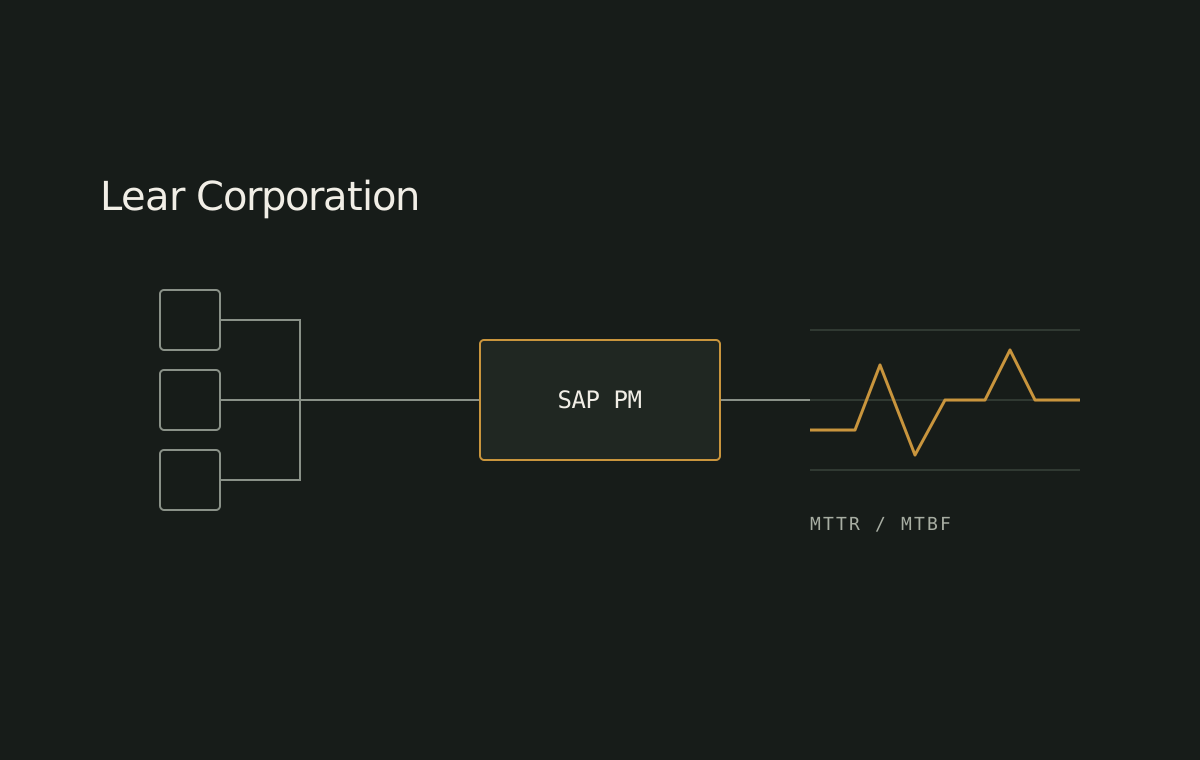
I incorporated metrics including mean time to repair (MTTR), mean time between failures (MTBF), availability and downtime, together with the internally used TMBF metric for mean good operating time, adapting their calculation to the real conditions of the plant.
I defined criteria for counting failures and designed an asset-criticality policy in which equipment capable of stopping production was classified as AA, the highest criticality level.
Prioritization combined data with direct plant work, conversations with responsible teams, recurring issues, repair times and operational needs.
ε
Automation and reporting
I designed a recurring flow to transform SAP PM records into management information.
I used SQL to extract and structure equipment information and Python to transform and integrate different types of data generated throughout the process.
Data extracted from SAP was organized into a structured location; Power Query performed additional transformations and Power Automate coordinated parts of the update workflow.
Power BI provided different levels of analysis for maintenance teams, plant leaders and management.
Based on the analysis, I also provided recommendations on priorities and potential equipment acquisition or replacement when maintenance patterns justified evaluating those alternatives.
ζ
Predictive maintenance, standardization and adoption
I extended the methodology into predictive maintenance by designing the operating structure within SAP PM for external temperature and vibration studies.
Measurements and specialized diagnostics were performed by external providers; my responsibility was to define how those results entered the system and became part of the maintenance-management process.
I aligned the methodology with the company's quality documentation and trained the maintenance organization and plant leaders in the new way of working.
η
Result and technologies
The maintenance area moved from relying mainly on Excel, manual processes and individual operational knowledge to a structured methodology supported by SAP PM, documentation, automation and recurring reporting.
Maintenance information could then be used to identify recurring problems, prioritize assets, evaluate availability and reliability, support preventive and predictive maintenance and communicate the state of the system to management.
The main outcome was not an isolated dashboard, but the progressive construction of a data-driven maintenance-management system.
Technologies and methodology: SAP PM, SQL, Python, Excel, Power Query, Power Automate, Power BI, TPM and continuous improvement.